How to Choose the Best Cooling Heat Sink for Your Needs?
Choosing the right cooling heat sink is critical for optimal thermal management in electronic devices. According to Dr. Emily Chen, a leading expert in thermal engineering, "A well-designed cooling heat sink can significantly enhance device performance." This statement underscores the importance of selecting an efficient cooling solution tailored to specific applications.
When assessing your needs for a cooling heat sink, consider factors like material, size, and airflow. Aluminum and copper are popular materials due to their excellent thermal conductivity. However, each material has different weight and cost implications. The dimensions of the heat sink should match your space constraints. An oversized heat sink may hinder device functionality, while an undersized one can lead to overheating issues.
Understanding airflow is also crucial. Active cooling solutions often require fans, which add complexity and noise. Passive solutions, on the other hand, rely on natural convection but may not suffice in high-performance scenarios. Each option has pros and cons. Therefore, reflecting on specific requirements and environmental conditions is essential for making an informed choice.

Understanding the Importance of Heat Sinks in Electronics Cooling
Heat sinks play a crucial role in electronics cooling. They dissipate heat generated by components like CPUs and GPUs. Without effective heat dissipation, devices can overheat. This can lead to reduced performance or even failure. Heat sinks enhance reliability and prolong the lifespan of electronic devices.
Choosing the right heat sink requires careful consideration. Factors like material, size, and design matter. Aluminum and copper are popular materials due to their thermal conductivity. A larger surface area usually offers better heat dissipation. However, a large heat sink may not fit all devices. Each application is unique and must be evaluated individually.
Many overlook the importance of airflow. Adequate airflow improves heat transfer. Even a high-performance heat sink can underperform if airflow is restricted. Considering the environment is essential. For example, dust accumulation can impede function over time. It’s important to keep these details in mind when selecting a heat sink.
Key Factors to Consider When Selecting a Heat Sink
Choosing the right heat sink is crucial for effective thermal management in electronics. Several key factors should guide your selection process. First, consider the thermal resistance of the heat sink. Lower thermal resistance typically means better heat dissipation. According to industry reports, a thermal resistance of less than 1°C/W is ideal for high-performance applications.
Next, analyze the size and dimensions of the heat sink. A larger surface area allows for improved airflow and heat transfer. Ensure that the size fits within the constraints of your design. Moreover, consider the material. Aluminum and copper are common choices. While copper has higher thermal conductivity, aluminum is lighter and often more economical.
Tip: Always conduct a thermal analysis to verify that the selected heat sink meets your system's cooling requirements. This avoids overheating, which can lead to component failure.
Review the airflow characteristics in your environment. Active cooling methods can enhance heat sink performance but may introduce additional factors, such as noise and power consumption. Choose a balanced solution that suits your project. Remember, a one-size-fits-all approach rarely works in thermal management. Each application has unique needs.
How to Choose the Best Cooling Heat Sink for Your Needs?
This chart illustrates the key factors to consider when selecting a heat sink. Each factor is rated based on its importance for effective cooling. The values indicate that thermal conductivity is the most critical attribute, followed closely by the material and size. Cost and weight are considered less important but still significant.
Comparison of Passive vs. Active Cooling Solutions for Heat Sinks
When choosing a heat sink, understanding cooling solutions is essential. Passive cooling relies on natural convection to dissipate heat. This method often requires minimal maintenance and operates silently. According to industry reports, passive solutions can suffice for devices with lower heat loads, typically under 50 watts. They are simple and cost-effective, but their efficiency diminishes as thermal loads increase.
Active cooling, on the other hand, employs fans or liquid cooling systems to enhance heat dissipation. Data indicates that active cooling solutions can reduce operational temperatures by up to 30% compared to passive systems. However, they come with higher costs and require more maintenance. Noise levels can also increase, which may not be suitable for noise-sensitive environments. Analyzing specific heat requirements is critical to making the best choice. It's clear that each option has trade-offs, and the decision hinges on the unique circumstances of each application.
Material Choices: Aluminum vs. Copper for Optimal Thermal Conductivity
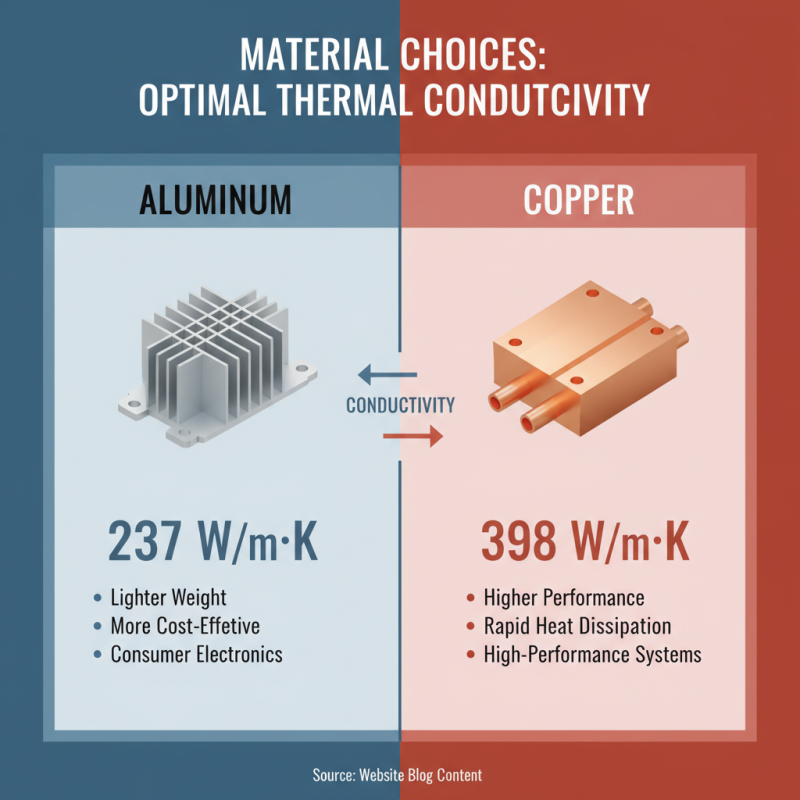
When selecting a cooling heat sink, one essential decision is the choice of material. Aluminum and copper are the two most common options. Aluminum is lighter and more cost-effective. Its thermal conductivity stands around 237 W/m·K. This makes it suitable for many applications, particularly in consumer electronics. In contrast, copper boasts a higher thermal conductivity at approximately 398 W/m·K, making it ideal for high-performance systems that require rapid heat dissipation.
TIP: If weight is a concern, start with aluminum. However, evaluate your system's thermal management needs.
Both materials have their pros and cons. Aluminum may oxidize, affecting performance over time. Copper can tarnish and is heavier, which may complicate system design. A report by the International Journal of Thermal Sciences indicates that optimizing heat sink material is critical for device longevity and efficiency.
TIP: Consider your environment. If heat sinks will face extreme conditions, their material choices become even more crucial.
Ultimately, making an informed decision enhances performance and reliability. Balancing cost, weight, and thermal efficiency will lead to the best choice for your application.
The Role of Thermal Resistance and Airflow in Heat Sink Performance
When selecting a heat sink, understanding thermal resistance is essential. Thermal resistance measures how well a material can dissipate heat. A lower thermal resistance indicates better heat transfer. Choosing a heat sink with the right thermal resistance ensures that your electronic components operate within safe temperature limits.
Airflow plays a significant role in heat sink performance. Adequate airflow helps carry heat away from the heat sink. Without proper airflow, even the best heat sink can underperform. When designing a cooling solution, consider fan orientation and placement. Effective airflow can counteract high thermal resistance.
Achieving an optimal balance between thermal resistance and airflow often requires experimentation. The most efficient heat sink for one project may not suit another. Tracking temperature changes during operation can provide valuable insights. Regular evaluation of thermal management strategies is crucial for improving performance.
How to Choose the Best Cooling Heat Sink for Your Needs?
| Heat Sink Material |
Thermal Conductivity (W/m·K) |
Max Operating Temperature (°C) |
Base Thickness (mm) |
Airflow Rate (CFM) |
Thermal Resistance (°C/W) |
| Aluminum |
205 |
150 |
5 |
50 |
0.45 |
| Copper |
397 |
200 |
6 |
60 |
0.35 |
| Graphite |
150 |
100 |
4 |
40 |
0.55 |
| Aluminum with Copper Core |
250 |
180 |
5 |
55 |
0.40 |






 Mr. Perry Wu International Sales Director